Plantar Fasciitis Massage — What Helps
Heel pain that is worst on the first step out of bed is usually plantar fasciitis. Here is what massage genuinely helps, what makes it worse, and when to send the client to a doctor instead.
Short answer
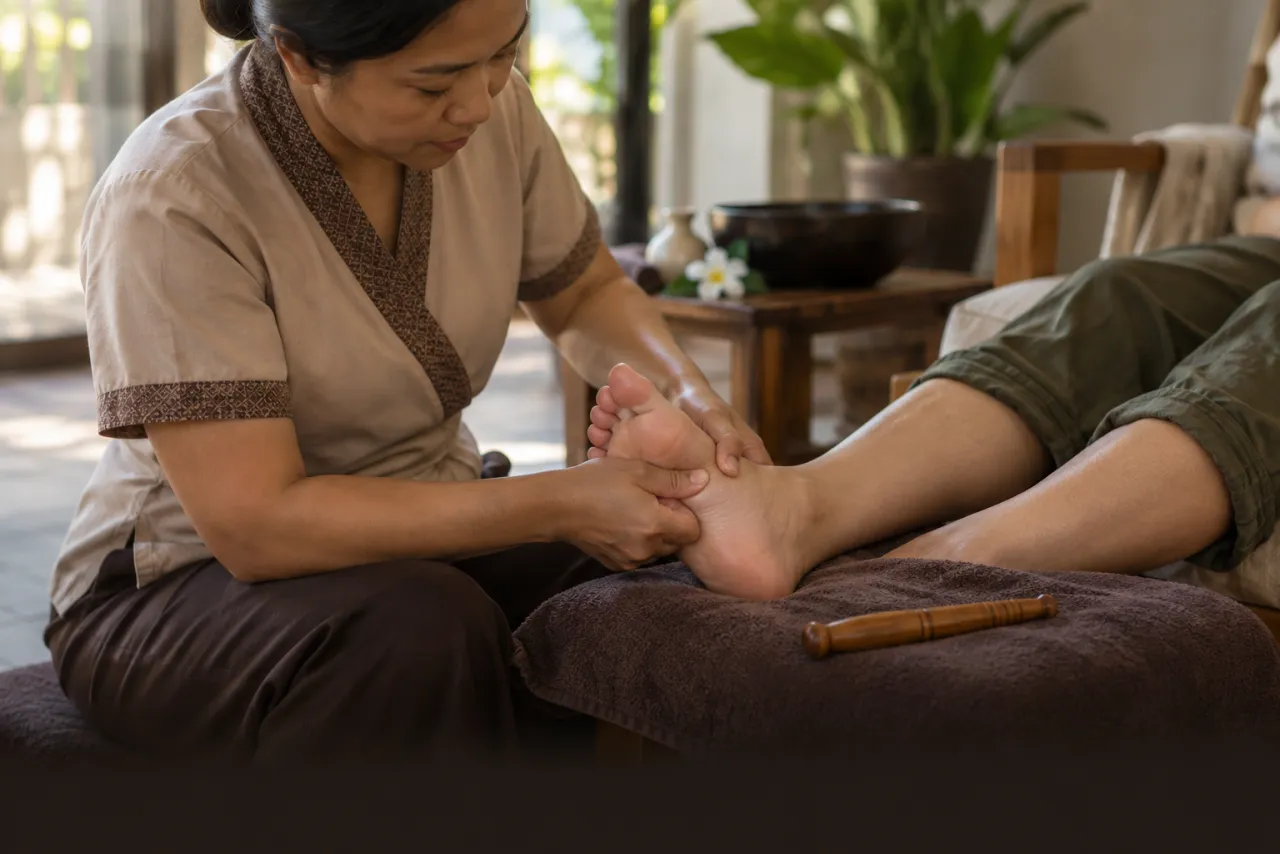
Plantar fasciitis is irritation of the thick band of tissue running along the sole from the heel to the toes, and its signature is sharp heel pain on the first few steps after waking. Massage helps by releasing the calf, Achilles tendon and the intrinsic muscles of the foot, which are what pull on that band in the first place. Pressing hard directly into the inflamed point at the heel usually makes things worse rather than better. If the pain lasts beyond about six weeks, or comes with numbness, swelling or night pain, the client needs to see a doctor before any more massage.
This article is written for massage therapists and students so they can work safely and recognise what is outside their scope. It is not medical advice, and health massage is not diagnosis or treatment of disease.
If you train in Thailand and then go and work anywhere in the world, heel pain will walk through your door regularly. It is one of the most common complaints a foot-focused therapist sees — and one of the easiest to make worse with confident, well-meant, badly aimed pressure.
What is actually going on
The plantar fascia is a tough sheet of connective tissue stretched from the heel bone forward to the base of the toes. It absorbs impact and supports the arch. When it gets pulled repeatedly beyond what it tolerates, the point where it attaches to the heel becomes irritated and painful.
The pattern that identifies it
- Sharp heel pain on the first few steps after getting out of bed, easing after a few minutes of walking
- The same thing again after sitting for a long stretch and then standing up
- Worse by the end of a day spent standing
- A specific tender spot in the middle of the heel, slightly toward the inside edge
That first-step pain is the detail worth asking about. Most other causes of foot pain do not behave that way.
Who tends to get it
- People who stand all day for work — massage therapists very much included
- Anyone whose body weight has climbed quickly
- Regular wearers of flat, thin-soled shoes
- People with genuinely tight calves and Achilles tendons
- Someone who has just increased their running or walking sharply
If you are reading this as a student who plans to be on your feet for decades, take that first point seriously. It sits alongside the wrist and thumb problems that end careers early as one of the occupational hazards worth getting ahead of.
Where massage genuinely helps
This is the part most people get backwards. Massage is not repairing the irritated tissue at the heel. It is reducing the force pulling on it, and that force comes from above.
| Where to work | Why it matters |
|---|---|
| Calf — gastrocnemius and soleus | A tight calf pulls the Achilles, which pulls the heel, which pulls the fascia |
| Achilles tendon | Continuous with the plantar fascia through the back of the heel |
| Intrinsic muscles of the sole | Lets the arch do its own job again |
| Hamstrings | Tightness carries down the chain into the calf |
Releasing a tight calf often does more for heel pain than working the heel itself. Students are routinely surprised by this, and it is usually the moment the anatomy starts making sense to them.
What not to do
Do not drive pressure into the inflamed point
The tender spot in the middle of the heel is the irritated attachment. Leaning an elbow or a thumb into it hard does not release anything — it adds insult to tissue that is already unhappy. The client will often say it felt good afterwards, because the body dampens pain in the moment, and then report that the next morning was the worst in weeks.
Do not force the ankle into a stretch
Irritated tissue does not respond well to being yanked. Slow, gentle, gradual — or not at all.
Do not promise a cure
It is not true, and it is not something a health massage provider should be saying. If the client goes back to the same shoes and the same ten-hour shifts, the pain comes back, and the promise is what they will remember.
Signs to stop and refer
Stop the session and tell the client to see a doctor if any of these are present:
- Numbness, tingling or shooting pain into the toes — this may be a nerve problem rather than the fascia
- Swelling, redness or heat in the area
- Pain at night with no weight on the foot
- Onset after a fall, an impact or an awkward landing — a bone injury is possible
- No improvement after roughly six weeks of sensible self-care
Knowing when not to work is a professional skill in its own right, and spa managers notice which therapists have it.
What you can reasonably suggest
General self-care advice, not treatment:
- Stretch the calf and Achilles regularly, including before getting out of bed
- Choose shoes with real arch support instead of flat thin soles
- Break up long periods of standing where the job allows it
- Roll the sole gently over a ball or a chilled bottle
Learning to work the foot properly
Foot work is not a list of pressure points to memorise. It only becomes reliable once you know the anatomy of the foot and lower leg well enough to reason about where a symptom is coming from.
Our 60-hour foot massage course at Michael Thai Massage School teaches anatomy, reflex zones and contraindications together, for exactly this reason — a therapist who knows when to stop is worth more to a spa than one who is only strong.
If you are weighing up whether foot work suits you, this overview of learning foot massage covers the practical side, and office syndrome is the other complaint you will meet constantly.
In short
- Plantar fasciitis is irritation where the plantar fascia attaches at the heel, and the giveaway is first-step morning pain
- Working the calf and Achilles usually beats working the heel, because it reduces the pull rather than attacking the sore spot
- Heavy direct pressure on the inflamed attachment tends to make it worse
- Numbness, swelling, night pain, injury or six weeks without improvement all mean refer, not treat
Questions about which course fits what you want to do? Get in touch — we would rather talk it through than have you book the wrong thing.
Frequently asked questions
Can you massage a client with plantar fasciitis?
Why is it worst on the first step in the morning?
How many sessions does it take?
Is this common in therapists themselves?
When should a therapist refuse to treat and refer out instead?
Related courses
- Foot Reflexology for Health — 60 HoursTuition 4,900 THB
- Thai Massage for Health — 150 HoursTuition 4,900 THB
Related searches
Serious about starting? Talk to us first.
Free LINE consultation