Can Foreigners Get Massage Certified in Thailand?
What a non-Thai can and cannot get when training here — the school certificate, the government practitioner card, and the visa question nobody answers clearly.
Short answer
Yes — foreigners can enrol in an accredited Thai massage course and receive a bilingual Ministry of Education certificate that is recognised internationally. What a foreigner generally cannot do on a tourist visa is work in Thailand afterwards. The certificate and the right to work in Thailand are two separate things, and most schools blur them. Michael Thai Massage School runs 150-hour and 60-hour courses from 4,900 THB in Bangkok and Pattaya.
Every week someone messages us from overseas asking the same thing in slightly different words: can I actually get certified here, as a foreigner?
The answer is yes — but the question people are really asking usually hides a second question underneath, and almost nobody separates the two properly. So let us separate them.
Two different things people call "certification"
This is the single most important distinction in this article, and getting it wrong costs people money and plane tickets.
1. The school certificate. A document from a training school saying you completed a course. If the school is accredited by Thailand's Ministry of Education, this certificate is verifiable — an employer anywhere in the world can check that the school is real and registered. Anyone can earn this, regardless of nationality.
2. The Thai practitioner registration. The government registration card that permits someone to work as a health-massage practitioner inside Thailand, issued under the Department of Health Service Support. This is tied to working in Thailand, and that brings in immigration and labour rules that have nothing to do with how good you are at massage.
Schools that advertise "get certified and work in Thailand!" are collapsing these two into one. They are not one thing.
What a foreigner definitely gets
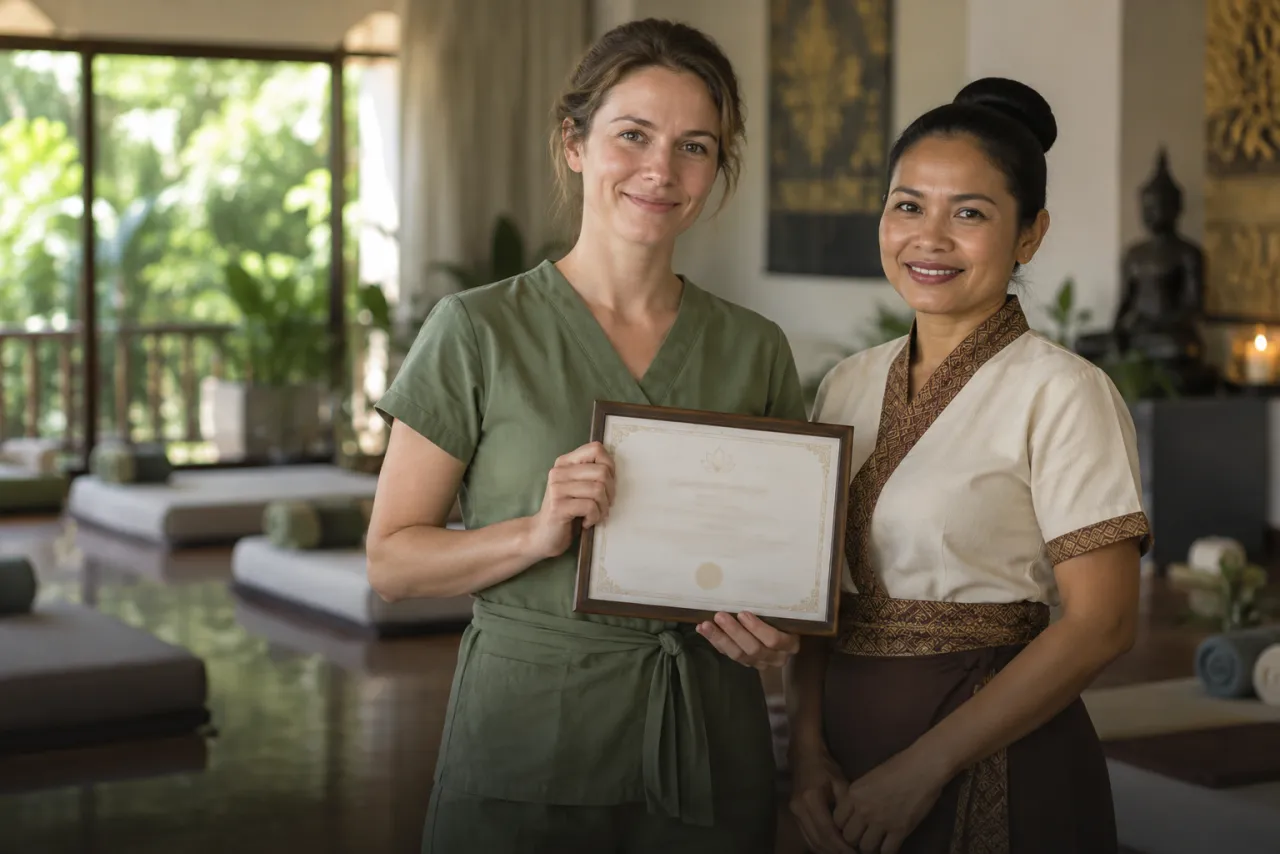
If you train at an accredited school, you leave with a bilingual certificate in Thai and English. Ours is issued that way deliberately — a certificate only in Thai script is close to useless when you hand it to a spa manager in Dubai or a cruise line recruiter in Miami.
You also leave with the thing that actually gets people hired, which is not paper at all: a full set of sequences you can perform confidently on a stranger without hesitating. Employers test that in a trade test. No certificate survives failing a practical.
The part most articles avoid
Working in Thailand as a foreigner is a separate matter from training in Thailand.
Employment in Thailand requires the correct visa and a work permit arranged through an employer, and massage therapy is an occupation where restrictions apply to non-Thais. This is immigration and labour law, it changes, and it depends on your nationality and circumstances.
We are a massage school, not immigration lawyers, and you should be suspicious of any school that answers this question breezily. What we will do is tell you honestly what we see: the large majority of our foreign students train here and then work somewhere else. That is the realistic path, and it works well.
Where foreign-trained therapists actually go
Our graduates work in international hotels, spas and cruise lines — Sofitel, Shangri-La, Marriott, Pullman, Anantara, Norwegian and Oceania Cruises among them. For those roles, what matters is:
- A verifiable certificate from an accredited school
- Enough documented training hours to clear the employer's minimum
- The ability to pass a practical trade test
- The country's own licensing rules, which vary enormously
That last point deserves emphasis. Some countries let you practise with no licence at all. Others — several US states, parts of Canada, Australia — require local registration, sometimes with more hours than a Thai course provides. Check your destination's rules before you book, not after. A 150-hour certificate that needs to be 500 hours where you live is an expensive lesson.
Why train in Thailand at all, then
Because this is where the tradition comes from, the training is dense, and the price is not comparable to anywhere else.
A 150-hour accredited course here costs 4,900 THB — roughly what a single weekend workshop costs in Europe or North America. You are also training in a country where the technique is everyday practice rather than an exotic import, which means your instructors have corrected thousands of pairs of hands.
If you want the full picture on cost including living expenses, we broke it down in how much a Thai massage course costs.
Which course to take as a foreigner
| Course | Hours | Price | Best for |
|---|---|---|---|
| Thai Massage | 150 | 4,900 THB | The foundation. Take this first if you take one thing. |
| Oil / Aromatherapy | 150 | 4,900 THB | Hotel spas and cruise ships overwhelmingly want oil work. |
| Foot Massage | 60 | 4,900 THB | Fast to add, very employable, easy on your hands. |
| Face Massage | 60 | 24,700 THB | Pairs with beauty and wellness roles. |
Most people coming from abroad take Thai plus Oil. Hotels and cruise lines usually want both, and the 150-hour count on each is what clears employer minimums. If you are undecided, we compared them in Thai or oil massage — which to learn first.
Bangkok or Pattaya
We teach the same accredited curriculum on both campuses, so choose on logistics rather than quality.
Bangkok (Si La Salle) sits directly at a BTS station, which matters if you are staying central and want to commute. Pattaya (Nong Prue) is next to the coach terminal, cheaper to live in, and sits inside the densest cluster of spas and hotels in the country — useful if you want to see the industry you are training for. There is a fuller comparison in our Pattaya guide.
Practical notes for overseas students
- Language is not a barrier. Massage is taught by demonstration and hands-on correction. Written materials and the certificate are bilingual.
- Class runs 08:30–17:00, closed Mondays. A 150-hour course is about 19 teaching days.
- You will be tired. This is physical work for eight hours a day. Book accommodation close to the campus.
- Bring your questions about your own country's licensing. We will tell you what we know and tell you plainly when we do not know.
Before you book a flight
Three things to confirm, in this order:
- Your destination country's licensing rules. This decides whether the course is useful to you at all.
- Your visa position for the length of stay you need — confirm with a Thai embassy or consulate for your passport, not a forum post.
- That the school is actually accredited and the certificate is bilingual. Ask to see the registration. A school that hesitates has told you what you need to know.
Summary
Foreigners can train in Thailand and receive a verifiable, internationally readable certificate — that part is straightforward and thousands of people do it every year. Working in Thailand afterwards is a different question governed by immigration and labour rules, and any school that tells you otherwise in a sales pitch is not being straight with you.
Train here for the quality and the price, then work where you are legally able to. That is the honest version.
If you want to talk through your specific situation — your nationality, where you intend to work, which courses make sense — message us and we will give you a straight answer, including when the answer is that Thailand is not the right choice for you.
Read next
Frequently asked questions
Can a foreigner take a Thai massage course in Thailand?
Can a foreigner work as a massage therapist in Thailand after training?
Is a Thai massage certificate recognised abroad?
What visa do I need to study massage in Thailand?
Do I need to speak Thai to take the course?
Related courses
- Thai Massage for Health — 150 HoursTuition 4,900 THB
- Aromatherapy Oil Massage for Health — 150 HoursTuition 4,900 THB
Related searches
Serious about starting? Talk to us first.
Free LINE consultation