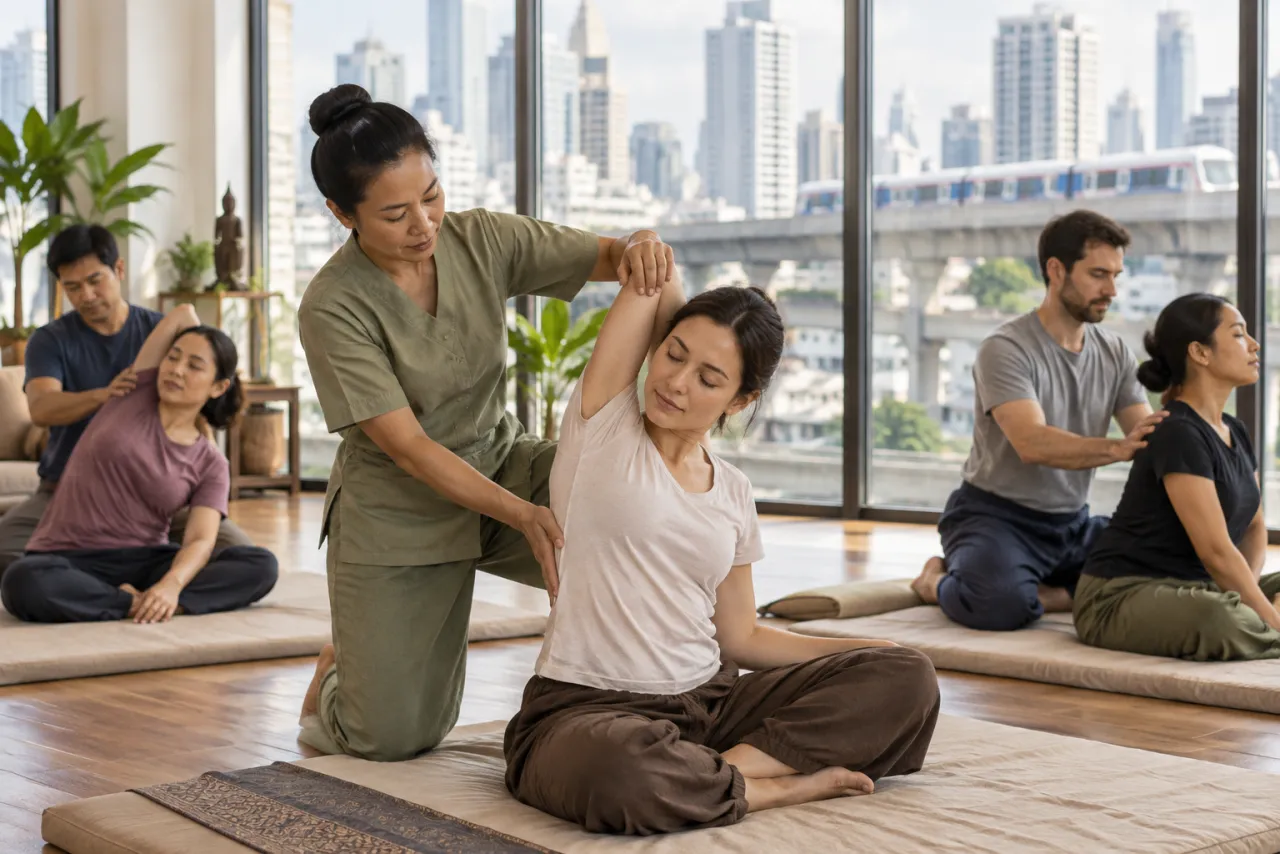
Studying Massage in Thailand — Complete Guide
Everything to know before training as a massage therapist in Thailand — accreditation, course length, real costs, registration and where to study.
Short answer
Training as a massage therapist in Thailand centres on the 150-hour Thai massage for health curriculum, accredited by the Ministry of Education and Ministry of Public Health. It takes about 19 days, costs roughly 5,000 to 20,000 THB at accredited private schools, and is the qualification that makes you eligible for Thai practitioner registration. Anything shorter, online-only, or from an unlicensed training centre will not qualify you to register or work legally in a Thai massage shop.
Thailand is where most people come to learn Thai massage, and for good reason. But the training market here ranges from free government classes to 40,000 THB retreats, and the difference between them is not obvious from a website.
This guide covers what actually matters, written by a licensed Thai school rather than a booking site.
The qualification that counts
Almost everything in Thai massage training orbits one number: 150 hours.
That is the length of the Thai massage for health curriculum accredited by Thailand's Ministry of Education and Ministry of Public Health. It is the threshold for registering as a practitioner, and it is what legitimate employers check.
| Course | Thai massage for health |
| Hours | 150 (about 19 days at 8 hrs/day) |
| Regulator | Department of Health Service Support |
| What you get | Certificate, then SorPorSor.14 practitioner registration |
| Lets you | Work in massage shops, spas, hotels, cruise lines; open your own shop |
| Does not let you | Advertise that you treat or cure medical conditions |
Anything under 150 hours, or delivered online only, does not meet the registration threshold — regardless of what the certificate says.
There is a separate, much longer route into Thai traditional medicine (800+ hours, professional licensing, clinics). That is a different legal track, not a higher rung on the same ladder.
The four questions to ask any school
Ask these before you pay anyone, us included:
1. Is the school licensed by the Ministry of Education? A licensed school has a registration number. A "training centre" or "academy" may not. Ask to see it.
2. Is the curriculum accredited by the Ministry of Public Health? This is what makes the hours count toward registration. Accreditation of the school and of the curriculum are separate things.
3. Does the certificate state the hour count, in English? Licensing bodies in other countries want the number on the document. A Thai-only certificate means paying for a certified translation later.
4. Do you practise on real clients? Watching demonstrations and working on classmates is not the same as working on strangers with real tension patterns. This is where confidence actually comes from.
What it costs
| Provider type | Price for 150 hours | Notes |
|---|---|---|
| Government vocational centres | Free – 1,000 THB | Long waits, usually under 150 hrs |
| Accredited private schools | 5,000 – 20,000 THB | The practical choice |
| Tourist-oriented retreats | 20,000 – 40,000 THB | Better holiday, not automatically better qualification |
| Online courses | 500 – 5,000 THB | Not registration-eligible |
Our Thai, oil and foot massage courses are 4,900 THB each (facial massage, 60 hours, is 24,700 THB), including a bilingual certificate, registration document preparation and free lifetime refresher classes.
Full breakdown including the hidden costs to ask about is in how much a Thai massage course costs.
Where to study
Chiang Mai
The most established international schools, the largest cohort of foreign students, the highest prices. Best if the experience matters as much as the qualification.
Bangkok
The most accredited schools per capita and the easiest transport. Our Bangkok campus is directly at BTS Si La Salle in Bang Na.
Pattaya
The fewest English-language schools but one of the densest job markets in the country. If you intend to work in Thailand, this is where graduates get hired fastest — see Thai massage school in Pattaya.
After the certificate — registration
The certificate is step one. Working legally in Thailand needs step two: SorPorSor.14 registration with the Department of Health Service Support.
Your school should prepare the paperwork with you rather than leaving you to work it out alone. Details in Thai massage practitioner registration.
Practical matters
Visas. Short courses are commonly taken on a standard tourist entry, but rules change and vary by nationality. Confirm with a Thai embassy before booking flights.
Language. Teaching is physical and technique is demonstrated hands-on, so limited Thai is workable. Confirm the language of instruction for your specific intake.
Physical demands. This is manual work. Expect real fatigue in the first two weeks while your hands, forearms and back adapt. Good schools teach you to use body weight rather than arm strength — that is what determines whether you can still do this in ten years.
Timeline. Nineteen days of class, then several weeks before you are genuinely fast and confident with clients. Anyone promising job-ready in a week is selling something.
Which course to start with
| Your goal | Start here |
|---|---|
| Work in Thailand, register as a practitioner | Thai massage 150 hours |
| Hotel and cruise spa work | Thai massage 150, then oil massage 150 |
| Start earning fastest, smallest budget | Foot reflexology 60 hours |
| Not sure yet | Foot reflexology 60 hours, then decide |
Comparison of the two main 150-hour courses is in Thai or oil massage — which to learn first.
Summary
- The qualification that matters is the 150-hour ministry-accredited course
- Verify the school's licence, the curriculum's accreditation, the hour count and the certificate language before paying
- Expect 5,000–20,000 THB at accredited schools; ours are 4,900 THB
- Registration (SorPorSor.14) is a separate step after the certificate
- Chiang Mai for the experience, Bangkok for convenience, Pattaya for the job market
Questions about which route fits your plans? Get in touch or browse all courses.
Read next
Frequently asked questions
What qualification do I actually need to work in Thailand?
How long does it take?
Can I study on a tourist visa?
Is a Thai certificate recognised in my country?
Chiang Mai, Bangkok or Pattaya?
Related courses
- Thai Massage for Health — 150 HoursTuition 4,900 THB
- Aromatherapy Oil Massage for Health — 150 HoursTuition 4,900 THB
- Foot Reflexology for Health — 60 HoursTuition 4,900 THB
Related searches
Serious about starting? Talk to us first.
Free LINE consultation