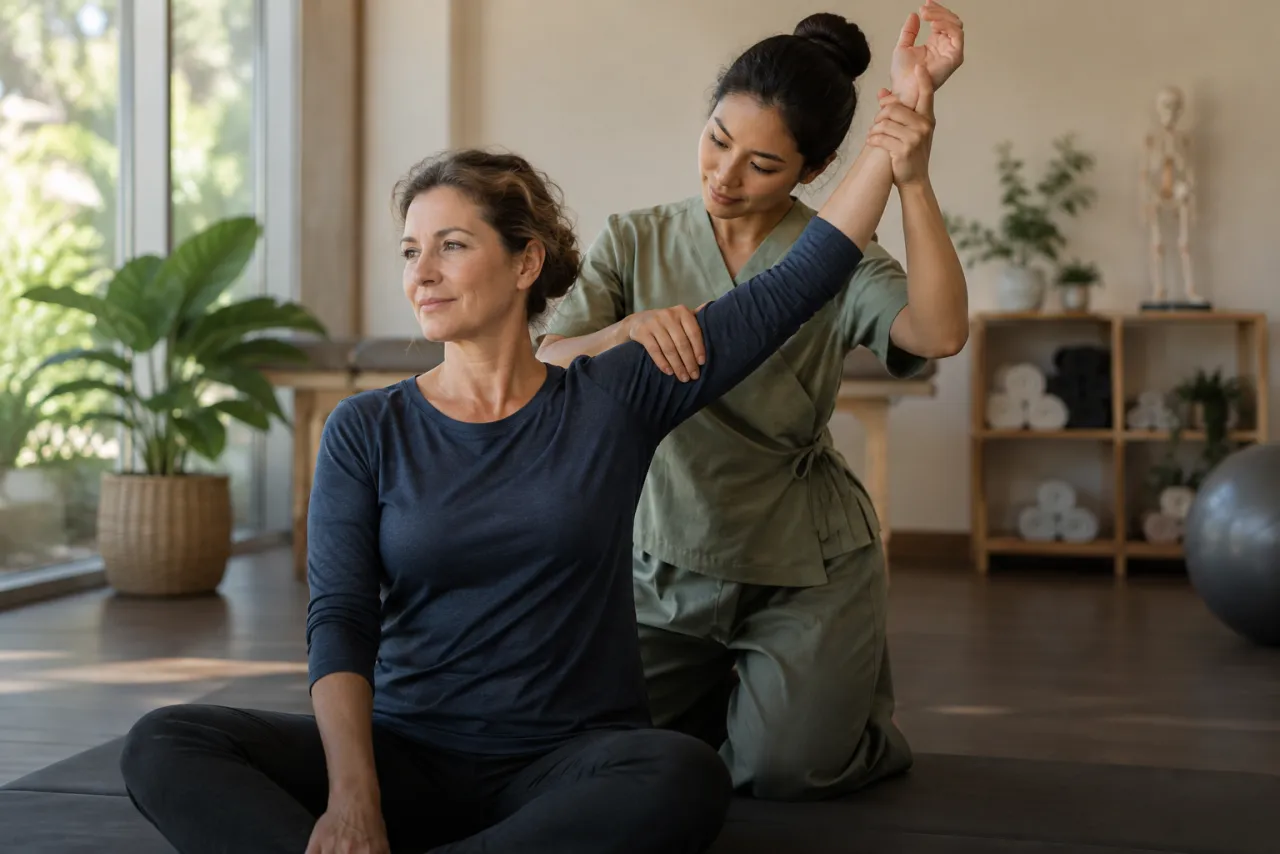
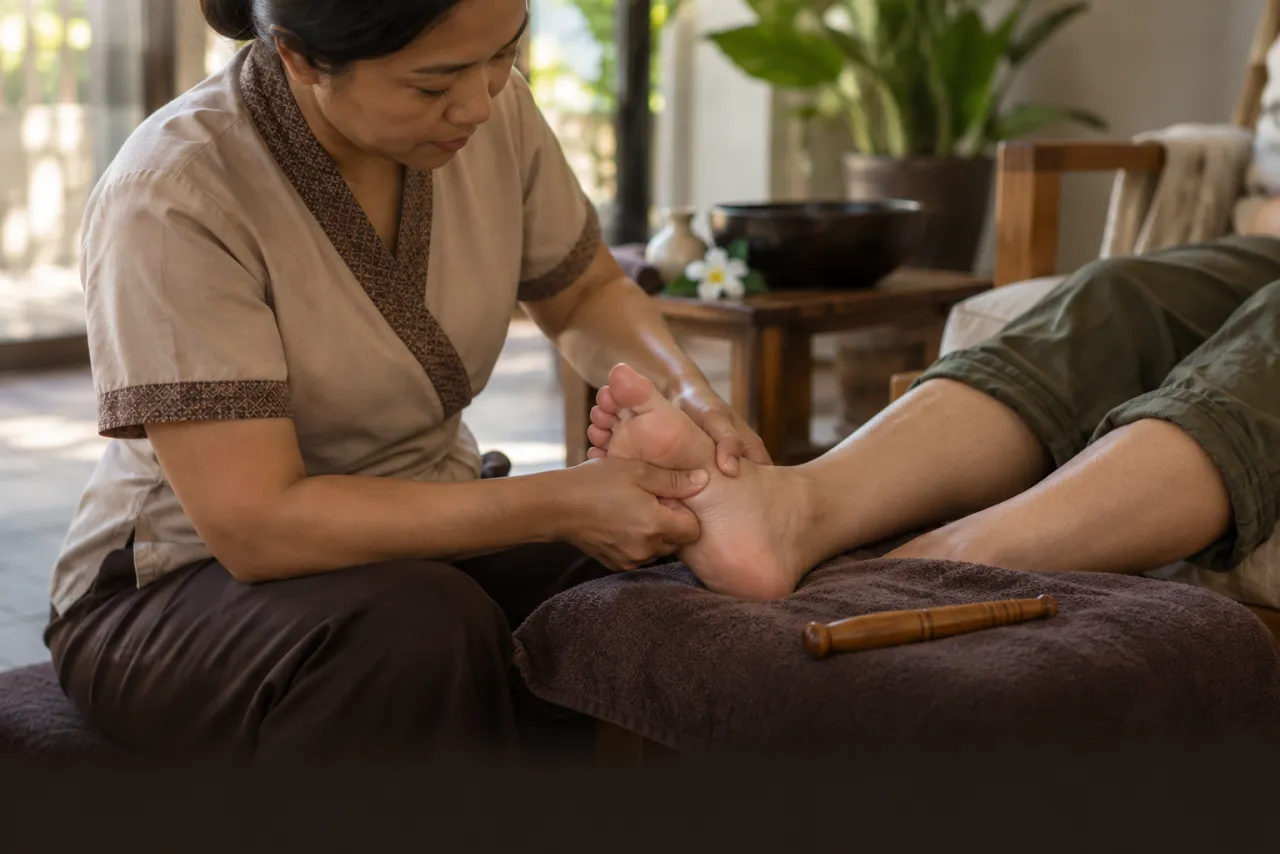
Massage for Knee Pain in Older Clients
Why pressing on a painful knee is the least useful thing you can do, which muscles actually need releasing, the techniques to avoid entirely, and the signs that mean the client needs a doctor first.
Short answer
Massage does not repair a worn knee joint, and nobody should claim that it does. What it can do is release the thigh, calf and hip muscles that have tightened from months of walking differently to avoid pain — and that compensation is often what the client actually feels, rather than the joint itself. Pressure on an older knee has to be lighter and slower than on a younger body, because skin is thinner and vessels more fragile. A knee that is swollen, red or hot, one that started hurting after a fall, or a single swollen calf all mean the client sees a doctor before anyone touches them.
This article is written for massage therapists and students, so they can work safely and recognise the edge of their own scope. It is not medical advice. Health massage is not the diagnosis or treatment of disease, and an older client with knee pain should be assessed by a doctor first.
"Can you do something about my mother's knees?" is one of the most common requests a therapist gets, and one of the most commonly handled badly.
Most people hear knee pain and put their thumbs straight onto the knee. That is usually the least useful thing available — and occasionally the most risky.
An older knee is not a younger knee
The joint has carried the whole body, every step, for several decades. With age the cartilage inside it thins, there is less fluid in the joint, and the thigh muscle that used to support it shrinks from being used less.
Three consequences matter at the table.
- The joint tolerates less force. Heavy pressure or forced stretching hurts sooner than you would expect.
- The surrounding muscle is weaker. The joint is left carrying load that muscle used to share.
- Skin is thinner and vessels more fragile. Pressure that leaves nothing on a thirty-year-old leaves a bruise here — and many older clients take medication that makes that worse.
The hand pressure you use on a fit younger client simply does not transfer.
What massage genuinely does
To be clear: massage does not thicken cartilage that has thinned. Anyone promising a cure is overselling.
What it does reach is the part that hurts from compensating — and that is frequently a bigger share of the pain than the joint itself.
When one knee hurts, the body changes the way it walks immediately and without permission: more weight onto the other leg, shorter steps, the knee held slightly bent all the time to avoid the painful end of its range.
The muscles that absorb that extra work stay tight, and that tightness pulls the joint further out of its natural line. Walking then makes it worse, which deepens the limp, which tightens the muscle again.
| Area to release | Why |
|---|---|
| Front of the thigh | Attaches directly to the kneecap; when tight it drags the kneecap off its track |
| Back of the thigh | Shortened by months of walking with the knee half-bent, so the leg no longer straightens fully |
| Calf and Achilles | Tight calves change how the foot loads, and that travels up to the knee |
| Hip and glutes | Too weak to control the line of the leg, so the knee rolls inward with every step |
| The leg that does not hurt | Has been carrying the extra load for months and is often tighter than the painful side |
The most frequently skipped area is the leg the client says is fine. Release it and you will often find it is the tighter of the two.
What not to do
Do not press directly onto the joint
The front of the knee is almost entirely bone, tendon and ligament rather than muscle. Pressing it releases nothing and irritates plenty. Work above and below instead.
Do not force the knee to bend
A common mistake is folding the leg toward the chest to "open the joint up". In an older knee with reduced space, that leaves the client sore for days. Every movement slow, inside the pain-free range, and stopped the moment it meets resistance.
Do not work on a single swollen leg without asking
One leg swollen, deep tenderness in the calf, skin warm or discoloured — those are referral signs, every time, not something to try gently and see.
Do not promise a result
These clients have been to several places and heard plenty of promises. Saying honestly that you can make walking more comfortable, and that this is relief rather than treatment, earns more trust than a guarantee does — not less.
🚨 Signs to stop and refer
- Swollen, red or hot knee, or any fever alongside it
- Pain that began after a fall or an impact — a fracture or a torn ligament is possible
- A visibly deformed knee, or one that cannot take weight at all
- One leg swollen with deep calf tenderness
- Numbness or weakness travelling down into the foot
- Recent knee surgery or a joint replacement with no medical guidance yet on what is allowed
Referring is not losing a client. It is the reason the family calls you back.
What you can advise without overstepping
A therapist can talk about how someone uses their body day to day without going anywhere near treatment.
- Less deep knee flexion — long periods sitting cross-legged on the floor, or squatting to wash dishes
- Fewer repeated trips up and down stairs; when unavoidable, lead up with the stronger leg and down with the less painful one
- Move often rather than sitting still for hours — a joint that never moves stiffens further
- Shoes with real cushioning affect the knee, not only the foot
Medication, supplements and joint injections are not our scope and not our opinion to give. The same boundary applies to elderly clients generally.
Why this case needs anatomy, not a memorised routine
Knee pain in an older person has several possible causes that call for completely different responses. Some benefit from massage. Some must not be touched. Some need a doctor today.
A therapist trained only in a fixed sequence cannot tell them apart and tends to press the same points on every client.
At Michael Thai Massage School anatomy is taught alongside technique rather than added at the end, because Dr. Michael came to this from a veterinary background and explains joints, tendons and muscle in a way that holds up in front of a real client. The same reasoning covers the other conditions you will meet constantly — frozen shoulder and plantar fasciitis among them — and it is what spa trade tests are really probing for.
In short
- Massage does not repair a worn joint; it reduces the compensating tension that makes walking harder
- Releasing the thigh, calf, hip and the non-painful leg does more than pressing the knee
- Older clients need lighter pressure and slower movement — thinner skin, less tolerant joints
- Swelling, heat, a recent fall, a single swollen leg or numbness into the foot → stop and refer
- Being honest about what a session achieves keeps clients longer than promising a cure
If you want to learn massage as reasoning about a body rather than a sequence to copy, look at the 150-hour Thai massage course, or get in touch and we will tell you honestly whether it suits what you are after.
Frequently asked questions
Can you massage an older client with knee pain?
Why work on the thigh and calf when the client says the knee hurts?
Which knees should never be massaged?
How many sessions before the client improves?
Is this worth training for if I plan to work in my own country?
Related courses
- Thai Massage for Health — 150 HoursTuition 4,900 THB
- Foot Reflexology for Health — 60 HoursTuition 4,900 THB
Related searches
Serious about starting? Talk to us first.
Free LINE consultation