How to Pass a Spa Trade Test — The Practical Interview
What actually happens in a spa trade test, what managers are feeling for while you work, and the mistakes that cost otherwise good therapists the job.
Short answer
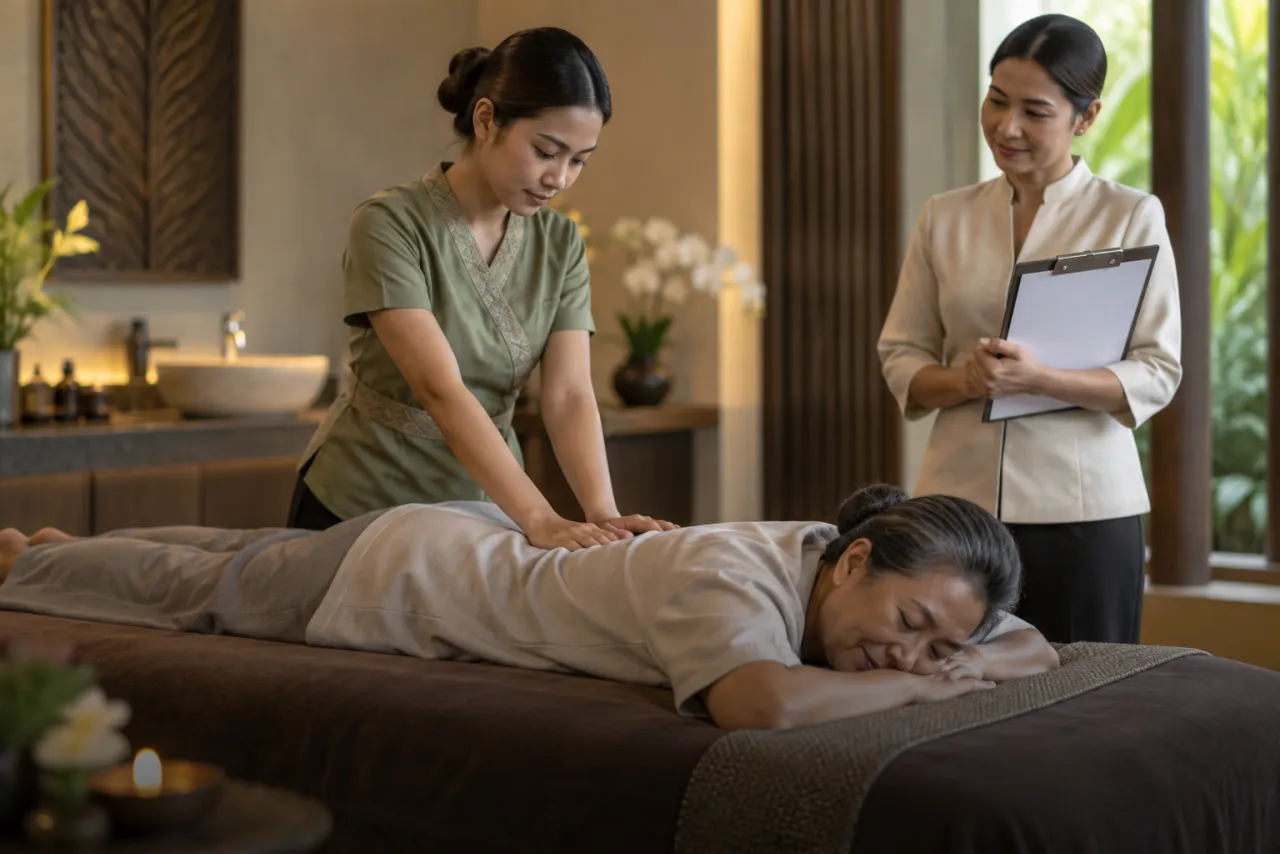
A spa trade test is a working interview where you give a manager or senior therapist a short massage, usually twenty to thirty minutes on one part of the body rather than a full session. They are assessing pressure control, hand contact, flow between moves, and whether you can hold a professional room — not how many techniques you know. Most candidates who fail do so for rushing, uneven pressure or breaking contact, all of which are fixable with practice before you apply.
Almost every massage job in Thailand — spa, hotel, resort, clinic-style shop — is decided the same way. You turn up, you work on someone for twenty or thirty minutes, and they tell you afterwards whether there is a job.
That is the trade test. It is the single most important twenty minutes in this career, and most people walk into it without knowing what is being measured.
Here is what actually happens, from the side of the person on the table.
What the test actually is
You will usually be asked to work on the spa manager, a senior therapist, or whoever currently holds the position you are applying for. Sometimes it is a full sequence. More often it is a section — back and shoulders, or legs and feet — because that is enough for an experienced person to know everything they need to know about your hands.
Expect twenty to thirty minutes. Ask when you book the appointment, because pacing a twenty-minute test as if it were an hour is one of the more common ways to lose it.
The room will usually be quiet. The person on the table may say almost nothing. That silence is not a bad sign — they are concentrating on what your hands are doing, not on making you comfortable.
What they are actually feeling for
This is the part almost nobody explains, so we will be direct about it.
Pressure control. Not strength. Control. Can you find a working depth and hold it steadily, and can you change it when asked without overshooting? A therapist whose pressure wanders — heavy, light, heavy again — feels unreliable to lie under, and that is disqualifying no matter how many techniques they know.
Contact. Good hands stay in touch with the body. Every time you lift both hands away to reposition, the person on the table notices, and a session full of small breaks feels choppy and unprofessional. Keep one hand resting while the other moves.
Flow between moves. Not the moves themselves. The joins. Beginners often perform a sequence of correct techniques that feel like a list being read aloud. Experienced hands make one move dissolve into the next so the receiver never has to reset.
Your body position. A manager who sits up afterwards will often glance at how you were standing. Therapists working from arm and thumb strength are visibly different from therapists dropping body weight through a straight arm — and the second kind is the one who is still working in ten years. We wrote about why this matters for your own longevity in what this work does to a therapist's body.
Whether you can hold the room. Confident greeting, clean hands, quiet movement, no fumbling with towels, no talking through nerves. It sounds cosmetic. It is not — it is most of what a guest experiences before your hands ever land.
What they are not testing
Not your certificate — that is why they gave you the appointment.
Not the number of techniques you know. Nobody is counting. A candidate doing eight moves beautifully beats a candidate doing thirty in a hurry, every time.
Not your speed — speed reads as anxiety. And not your age: the practical test is one of the reasons this trade stays open to people changing careers later, because the assessment happens entirely in the present tense. More on that in changing careers to massage therapy after 30.
The mistakes that cost people the job
Rushing. By far the most common. Nerves make hands fast, and fast hands feel thin. If you notice yourself hurrying, slow one single stroke deliberately and the rest will follow.
Pressure that never settles. Usually caused by not committing. Pick a depth in the first minute, work there, and adjust only when asked.
Talking too much. A few clear questions at the start — pressure, any areas to avoid, anything painful — then quiet. Filling silence with chat signals nerves.
Skipping the beginning and the end. Many candidates dive straight into technique and stop abruptly when the time is up. A short settling contact at the start and a clear finish at the end change how the whole session is remembered.
Cold hands, long nails, strong fragrance. Small things, all noticed, all fixable in the five minutes before you walk in.
Not asking about pressure at all. Managers read this as a therapist who works on autopilot rather than on the person in front of them.
How to prepare in the week before
Practise on people who are not classmates. Classmates are the same age, the same build, and they are being polite. Strangers have real tension patterns and real opinions, and they are the only honest test of whether your hands are ready.
Rehearse the specific length you have been given. Take a full back sequence and run it at twenty minutes until the timing is in your body rather than in your head.
Practise the opening thirty seconds and the closing thirty seconds until they are automatic, because those are the two moments when nerves show most.
And decide in advance what you will do if they ask for more pressure. The right answer is a slow, steady increase from your body weight — not a sudden dig with your thumbs.
After the test
Some spas tell you the same day. Many say they will call. Ask directly what the next step is and when, then follow up once if you hear nothing — persistence is read as interest here, not as a nuisance.
If you do not get it, ask what they would want to see improved. Managers who have just spent twenty minutes under your hands can give you the most useful feedback you will ever get, and most will give it if you ask plainly.
Where this fits in the wider picture
Trade tests are used across spas, hotels and resorts in Thailand, and the same style of practical assessment appears again if you later go for work abroad or on cruise contracts. Getting good at being tested is, in itself, a career skill.
It also explains something about training. A course that keeps you on classmates the whole way through leaves you technically correct and practically untested. When you are comparing schools, ask how much of the time is spent working on people you have never met.
At Michael Thai Massage School the core courses run 150 hours over about 19 days, with shorter 60-hour specialisms over about 8 days, and both campuses put students on real bodies rather than only on each other. If you want a sense of which course opens which doors first, Thai or oil massage — which to learn first covers the trade-offs.
Summary
- A trade test is twenty to thirty minutes of real work, usually on a manager or senior therapist
- They are assessing pressure control, contact, flow, body mechanics and professionalism — not technique count
- Rushing and wandering pressure are the two most common reasons good candidates fail
- Practise on strangers, rehearse the exact length, and rehearse the first and last thirty seconds
- Ask for feedback if you do not get the job; it is the most useful coaching available
Preparing for a test and want a second opinion on where your hands are? Get in touch — we would rather tell you honestly that you need two more weeks than watch you use up a good opportunity.
Frequently asked questions
How long does a spa trade test usually last?
Who will I be working on?
What if I do not speak much Thai or English?
Can I fail a trade test even with a good certificate?
How soon after finishing a course should I apply?
Related courses
- Thai Massage for Health — 150 HoursTuition 4,900 THB
- Aromatherapy Oil Massage for Health — 150 HoursTuition 4,900 THB
- Foot Reflexology for Health — 60 HoursTuition 4,900 THB
Related searches
Serious about starting? Talk to us first.
Free LINE consultation