Sports Massage Career — Who Actually Hires
Sports massage is one of the few specialities where demand outruns the number of trained hands. Here is who the clients are, what to learn first, and the downsides nobody mentions.
Short answer
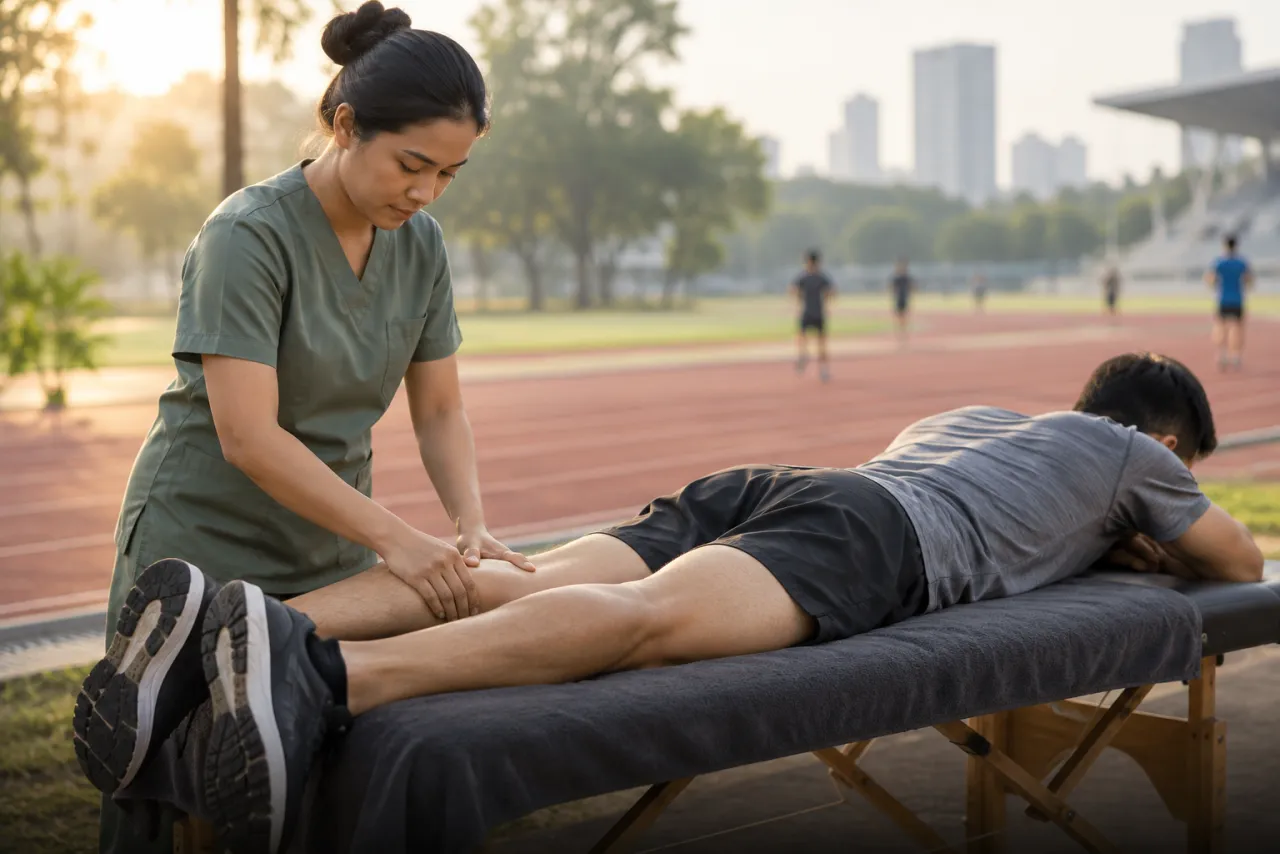
Sports massage is bodywork aimed at the muscle groups an active person overloads through training, done to relax tissue, support circulation and ease tightness after hard sessions. The clients are runners, gym members, cyclists and amateur athletes, and in most cities there are far more of them than there are therapists trained to work on them. It is a specialisation built on top of solid basics rather than a starting point — at Michael Thai Massage School the Sports Massage module runs 60 hours and is taken after a foundation course such as Thai Massage for Health, 150 hours.
Most massage clients arrive with pain from sitting still. There is a second group that arrives with pain from the opposite cause — moving too much — and the average shop is not set up to handle them well.
They are runners, gym members, cyclists, people playing football or badminton after work. Their tightness sits in different places from an office worker's, and what they want from a session is different too.
If you are training in Thailand and wondering where to take your hands afterwards, this is one of the few directions where clients are easier to find than colleagues. Here is the honest version of the work.
What sports massage actually is
It is not a separate catalogue of moves to memorise. It is a way of applying what you already know to a body that has been deliberately overloaded.
Three things make it different.
It is regional, not full-body. A runner comes in for calves, hamstrings and hips. Someone lifting comes in for shoulders, upper back and chest. You might spend half a session on one leg if that is where the tightness genuinely is, which feels wrong to a therapist trained only in fixed sequences.
Timing matters as much as technique. A client racing tomorrow and a client who finished a marathon yesterday need opposite sessions. The first should not leave the table with fatigued muscles. The second wants relaxation and circulation far more than depth.
You have to be able to talk about it. These clients know their own bodies well and can usually tell you exactly which movement hurts and when. Asking the right three questions before they lie down changes the session more than any technique you could add to it.
Why there is room in this market
You do not need a statistic to see it. Race events run most weekends across Thailand, gyms keep opening in malls and housing estates, cycling groups form in every district, and a lot of working adults now train far more seriously than a decade ago — loading their bodies hard without the recovery support a professional athlete takes for granted.
The more interesting half is the supply side. Most graduates head straight into health-massage shops or hotel spas, because those paths are clear and the jobs are already waiting. Comparatively few go looking for the sports side — even though the clients there are visibly short of people who understand what they do.
Who the clients are
| Client group | Usual tight spots | What they want |
|---|---|---|
| Distance runners | Calves, hamstrings, hips, soles | To be ready for the next training block |
| Gym and weight training | Shoulders, upper back, chest, arms | Tightness released after heavy sessions |
| Cyclists | Neck, lower back, quads | Relief from hours in one riding position |
| After-work amateurs | Calves, ankles, shoulders | To feel normal again before Monday |
| Beginners getting fit | Everywhere, legs especially | Help with soreness while the body adapts |
That last row is the one people overlook, and it is both the fastest growing group and the easiest to keep. Someone six weeks into their first training habit is meeting sensations they have never had before and has no idea what to do about them.
Where to start
The route that actually works looks like this.
- Build the foundation first. Thai Massage for Health, 150 hours teaches pressure control and how to read a body by feel — 19 days if you study full time. Everything specialised sits on top of that.
- Work on real people for six to twelve months. Dozens of clients, until your hands stop thinking. This step gets skipped often and should not be, because sports work asks you to make decisions faster than general massage does.
- Add the 60-hour Sports Massage module. It is an advanced module rather than an entry course, listed with the rest on the courses page.
- Consider oil massage too if spas are in the picture. A fair number of active clients book hotel spa treatments as well. The comparison between the two foundation courses is in Thai massage or oil massage — which to learn first.
Step two is the one people want to jump, and the one that decides whether the speciality sticks. Therapists who take an advanced module before working commercially tend to remember the moves and fail to apply them when the body in front of them does not match the classroom.
What the money looks like
Good per session, unreliable per month. That is the whole picture.
Specialist work commands more than a standard hour, and this client group pays it, because they are already investing in their training. But volume swings with race season and with how hard you chase clients — unlike shop work, where they walk in on their own.
Which is why most people do not abandon general work for this. They use it as the skill that lets them charge more, and build a regular client list slowly alongside a normal job. The broader picture of earnings by workplace is in what massage therapists actually earn, and if you are planning to take the skill out of Thailand, working as a massage therapist abroad covers that side.
The downsides
The hours are antisocial. Races start at four or five in the morning, and a service tent has to be set up before that. Gym clients are free after work and at weekends. Your free time will not match anyone else's.
You are your own front desk. Nobody sends you clients. The early months involve walking into gyms and talking to running clubs yourself, which plenty of good therapists find harder than the massage.
It is physically heavier work. Regularly trained muscle is denser than average. If you press with fingers instead of transferring body weight, your hands will tell you within a few years — the mechanics behind that are in will massage work wreck your hands.
Expectations are high. These clients book often and compare notes with each other, so they can tell good hands from average ones. The upside of the same trait is that word travels faster here than anywhere else.
The line not to cross
Say it plainly. Sports massage supports relaxation, circulation and muscular tightness. It does not treat injuries.
A client with swelling, acute inflammation, sharp pain, pain at a joint line, or pain that has not improved over time should see a doctor before booking a massage. The same goes for anyone with a medical condition who is unsure whether massage is appropriate for them at all.
Indications and contraindications are taught from the foundation course onward at Michael Thai Massage School, in Bangkok and in Pattaya, for the simple reason that knowing when not to work is what separates a long career from a short one.
In short
- Sports massage is applied judgement about overloaded muscle, not a new set of techniques
- Client numbers are growing across running, gyms, cycling and first-time exercisers, while trained therapists in the niche stay scarce
- The working route is a 150-hour foundation, real clients, then the 60-hour sports module
- Strong per session, unpredictable per month, so most therapists run it alongside shop or spa work
- Anything that looks like an injury goes to a doctor first; massage is not treatment
If you want a straight answer about which course fits your time and your goals, come and ask us. We will say so if a different speciality suits you better.
Frequently asked questions
How is sports massage different from Thai massage?
Do I need a foundation course before learning sports massage?
Where do sports clients come from?
Does sports massage pay better than general massage?
Can I work on a client who is injured?
Related courses
- Thai Massage for Health — 150 HoursTuition 4,900 THB
- Aromatherapy Oil Massage for Health — 150 HoursTuition 4,900 THB
Related searches
Serious about starting? Talk to us first.
Free LINE consultation